Plastic Pallet Rack Load: How to Compare Ratings
Two catalogue load figures are useful to compare only after you know which pallet configurations, supports and operating conditions they describe.
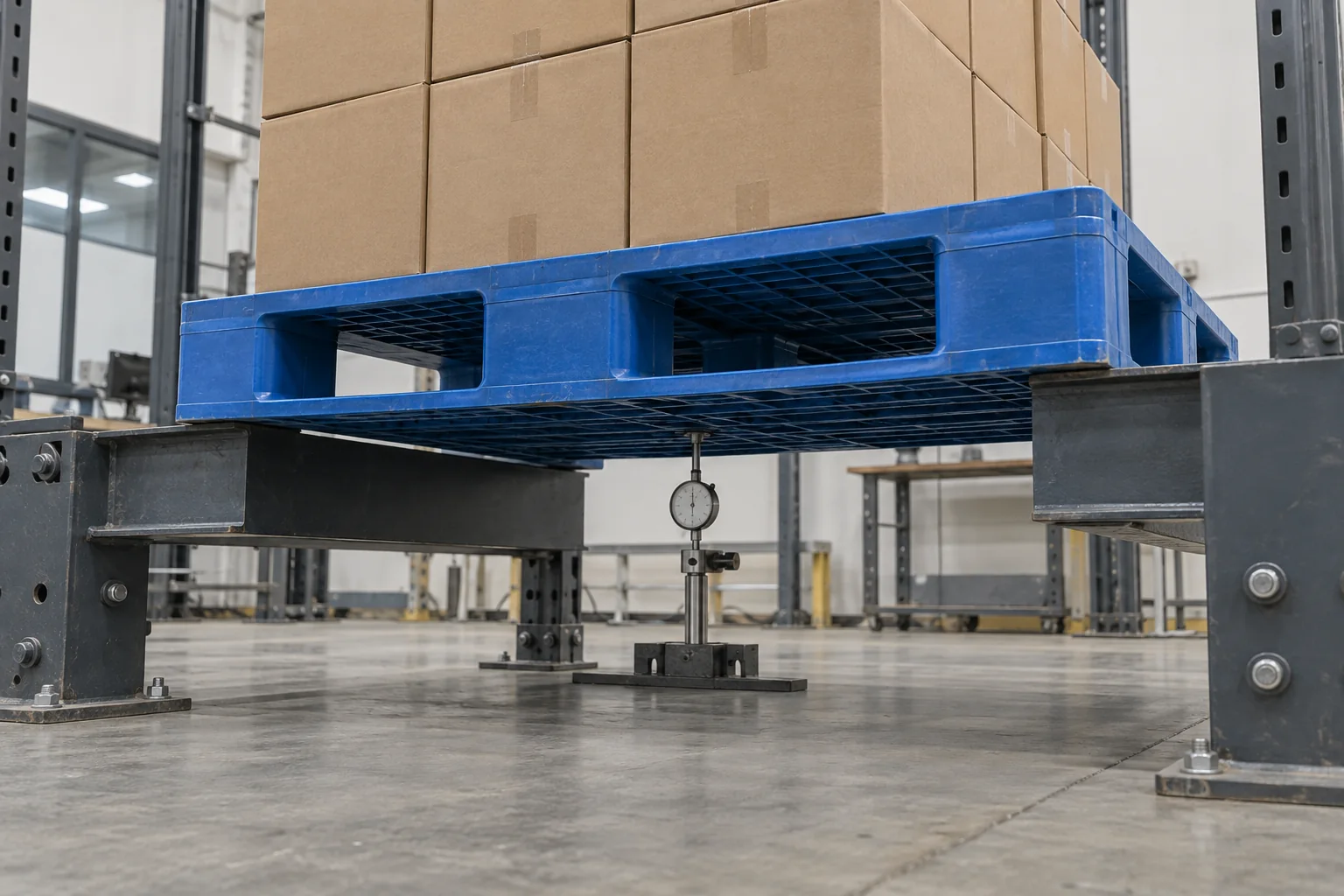
In this guide
Compare plastic pallet rack-load ratings by matching the configuration, payload and load distribution, support geometry, temperature, storage duration and evidence behind each figure. A larger number without those conditions does not establish a better choice for your rack or AS/RS.
This guide helps buyers decide which supplier information is comparable and what still needs confirmation. It does not calculate a load rating or specify a universal deflection limit. Use the AS/RS pallet selection guide for the wider equipment and purchasing review.
1. Identify what the quoted load figure means
Ask the supplier to identify the load type, units, test or assessment method, and whether the mass refers to payload or includes other components. Record the payload separately from the complete unit mass, including the pallet and packaging. Keep those definitions with the quotation.
A floor-supported static-load claim, a handling claim and a rack-supported claim describe different situations. Do not convert one into another with an assumed percentage. Likewise, a reported test load is not automatically the permitted payload for your warehouse; ask which result or working-load declaration supports the offered use.
ISO 8611-3:2011 addresses maximum working loads for new flat pallets with known payloads in different handling environments. That scope is a reason to attach the intended load and use to the number, rather than treat “rack load” as a property independent of the application.
Then identify the offered family + model + configuration + drawing revision. Include material specification, structural details and the steel-tube quantity, section, position and orientation where applicable. A report for a similar footprint or another reinforcement arrangement is not automatically evidence for the quoted configuration. More tubes alone do not establish a higher allowable load; see the reinforcement guide.
2. Draw the actual rack support
Record whether the pallet rests on beams, rails, a shelf or another support arrangement. On an underside view, mark the pallet orientation, support locations, contact widths and the relevant unsupported span. Include any support bars and the permitted pallet-positioning range supplied by the rack or system provider.
Clear span and support centre distance are different dimensions. Clear span describes the gap between the facing support surfaces; centre distance is measured between the support centrelines. Label the measurement endpoints on the drawing instead of sending an unlabeled “span” value. The support shape and actual contact positions still need review.
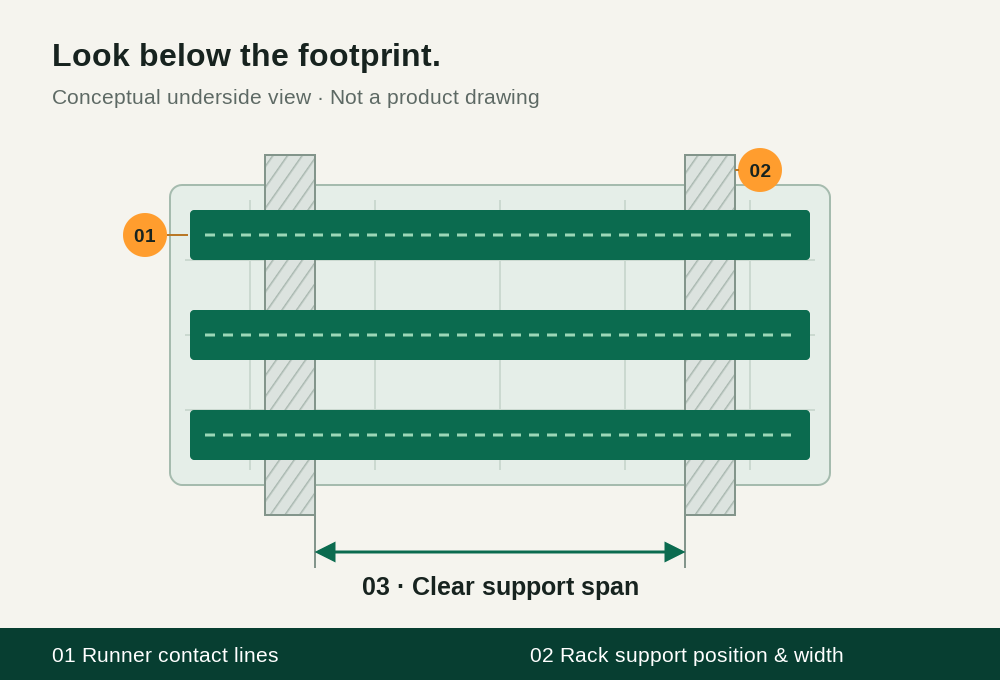
Ask whether the evidence covers that support direction and contact arrangement. A fully supported deck, two rack beams and a shuttle platform should not be treated as interchangeable just because they hold a pallet at the same elevation. Review the conveyor and shuttle interfaces separately for pickup and handover movements.
3. Keep the payload, temperature and time together
Provide a bottom-layer sketch or photographs showing where the goods touch the deck. Add individual contact dimensions for feet or concentrated packages, the loading pattern, any offset centre of gravity and how the load is restrained. Equal total mass does not describe equal contact conditions. Use the unit-load specification guide to organise these inputs.
Record normal and extreme temperatures at the relevant storage and handling stages, together with the longest continuous loaded storage time. Ask how the supporting evidence applies to those conditions. Do not infer weeks of rack storage from a short demonstration, or freezer suitability from a material name alone.
HSE’s Pallet safety guidance, pages 2–3, identifies load distribution, environment and racking arrangement as pallet-design inputs. Its discussion supports collecting the conditions; it does not provide a BAOHENG model rating or a universal allowance for your installation.
For deformation results, distinguish the change measured while loaded, any continuing change during the loaded period, and the deformation remaining after unloading and an identified recovery interval. Ask for the measurement locations, timing, reference points, results and applicable limits. A single photograph or the statement “no breakage” leaves those questions unanswered. The responsible engineering parties must define which measurements and criteria apply.
4. Read the report as evidence for a defined case
Request the relevant report or documented assessment, with its issuer, date, reference and applicable pages. Check that the specimen identity and conditions can be traced to the offered configuration. Distinguish a supplier declaration, an internal test and a third-party report; the identity of the issuer is part of the evidence, not a substitute for matching its scope.
The ISO 8611 parts have different purposes. The public catalogue abstracts describe them as follows:
| Reference | What to identify in the evidence |
|---|---|
| ISO 8611-1:2025 — test methods | Which relevant methods and test groups were used? |
| ISO 8611-2:2025 — performance requirements and test selection | Which requirements and selected tests support the stated assessment? |
| ISO 8611-3:2011 — maximum working loads | Which known payload and handling environment does the working-load determination cover? |
Mentioning “ISO 8611” on a quotation does not establish which part, edition, tests or results apply, and does not itself certify the product. This article uses the public abstracts, not the full standards, to explain the distinction; it does not reproduce their procedures or acceptance thresholds. Part 1 also notes the continuing value of field tests on specific pallet designs.
Use the following questions to compare the report with the intended use:
| Review item | If the connection is missing |
|---|---|
| Tested specimen versus offered configuration | Ask for the model, material and reinforcement link |
| Support and pallet orientation | Request the setup drawing and its dimensions |
| Payload and contact pattern | Obtain the loading arrangement and mass definition |
| Conditioning, temperature and duration | Ask what evidence covers the intended conditions |
| Measurements, results and limits | Request the relevant result and assessment pages |
| Working-load conclusion and exclusions | Ask the responsible reviewer to state the applicable scope |
A photograph of weights on a pallet can document part of a setup. By itself it does not show all the conditions, measurements or the resulting working-load decision.
5. Record the gap before approving or comparing options
Suppose one offer provides a rack-load figure and a documented beam setup, while another provides a higher static-load figure for a floor-supported condition. The next step is to request comparable rack-use evidence from the second supplier. Choosing the larger number would leave the original question unresolved. This is a comparison example, not a claim about particular suppliers or products.
For each candidate, record one of these review outcomes:
- Applicable evidence identified: the responsible reviewer has identified the configuration, conditions and conclusion that cover the intended rack use. Keep the evidence reference and any limitations.
- Clarification required: a definition, drawing, configuration link or result is missing. Name the question and who should answer it.
- Further assessment required: documented conditions differ from the proposed use. Agree the engineering review or evaluation needed; do not invent a derating factor to bridge the gap.
These are document-review outcomes, not automatic product approval. The rack or system provider and pallet supplier need to agree the applicable conditions and release process. Any sample evaluation must follow an approved plan with defined loads, support, environment, duration, measurements and acceptance criteria. Do not improvise an overload test in an operating rack. Connect the decision with the sample acceptance checklist.
6. Send one conditions sheet with each rack-load enquiry
Complete the intended-use section once, then repeat the candidate section for each offer. It helps suppliers respond to the same question and keeps an unknown condition visible. It is not a test method or a completed approval record.
Send BAOHENG the conditions sheet, support drawing, load-bottom sketch and candidate family/model, with the required quantity. We can use the available information to discuss candidate configurations and the documents or sample review needed next. Confirm the final configuration and applicable conditions in the purchasing record, including which changes require renewed review.
Sources and scope
- ISO 8611-1:2025, public abstract: test-method groups and the role of field tests.
- ISO 8611-2:2025, public abstract: performance requirements and test selection.
- ISO 8611-3:2011, public abstract: working-load determination for known payloads and handling environments.
- HSE — Pallet safety, PM15, fourth edition, pages 2–3: suitability and design inputs.
Sources reviewed on 12 November 2026. The worksheet and review sequence are editorial tools. They do not establish a BAOHENG load rating, certification, safety factor or universal deflection limit. The cover is an existing AI illustration; the support diagram is an explanatory schematic.
