When Does an AS/RS Plastic Pallet Need Steel Reinforcement?
Start with the rack support and load, then compare the available complete configurations and their evidence.
In this guide
Consider steel reinforcement when an available pallet configuration needs to be evaluated against your load, support and storage conditions. The decision is about the complete pallet, not the number of tubes alone. Some projects may be served by an unreinforced option; others may require further assessment of reinforcement. The supplier and system provider should confirm the final configuration for the project.
Start with the load and support
Map where the goods contact the deck and where the rack, conveyor or shuttle supports the pallet. Show the support direction, clear span, contact width and pallet orientation. Provide the payload and complete unit mass separately, the load distribution, temperature and maximum loaded storage time. For differing payloads, describe each relevant contact pattern: equal mass does not mean equal loading conditions.
ISO 8611-3:2011 addresses maximum working loads for new flat pallets with known payloads in different handling environments. Its scope is a reason to keep load and use conditions attached to any assessment. The rack-load comparison guide explains how to ask for the matching evidence.
Compare complete configurations
Ask which standard and reinforced configurations are available for the particular family and model. For each offer, request the drawing revision, material, pallet mass, reinforcement quantity, section and position, and any documentation applicable to the intended support and load. A range of possible tube counts does not identify the exact sample or production configuration.
| Project question | Information to compare |
|---|---|
| Rack use | Support drawing, load distribution, temperature, dwell time and evidence for each offered configuration |
| Handling route | Pallet height, underside, pickup openings, support areas and total moving mass |
| Environment | Exposure to water, cleaning agents or other relevant conditions, plus the supplier’s applicable reinforcement and maintenance guidance |
| Purchase and replenishment | Family, model, drawing revision, material and tube arrangement tied to the quote and sample |
Adding steel can change pallet tare mass and the total mass handled by equipment; compare the offered configurations rather than assuming a fixed increment. It may also affect transport quantity or environmental requirements, so ask the supplier for configuration-specific details. Reinforcement does not itself establish a rack rating, corrosion protection or equipment approval.
Decide what evidence is still needed
If the offered configuration and its evidence cover the stated conditions, ask the responsible reviewers to document the applicable limits. If the support, load, duration, temperature or tube arrangement differs, keep the item open and ask what additional assessment is needed. Do not assume a percentage increase in load capacity, invent a deflection limit or transfer a different model’s test result.
Where a sample evaluation is agreed, record the sample ID, exact construction and relevant drawing, and agree the load, support, environment, duration, measurements and acceptance criteria before testing. A brief trial does not by itself establish long-term storage performance. Use the sample acceptance checklist to retain results and unresolved items.
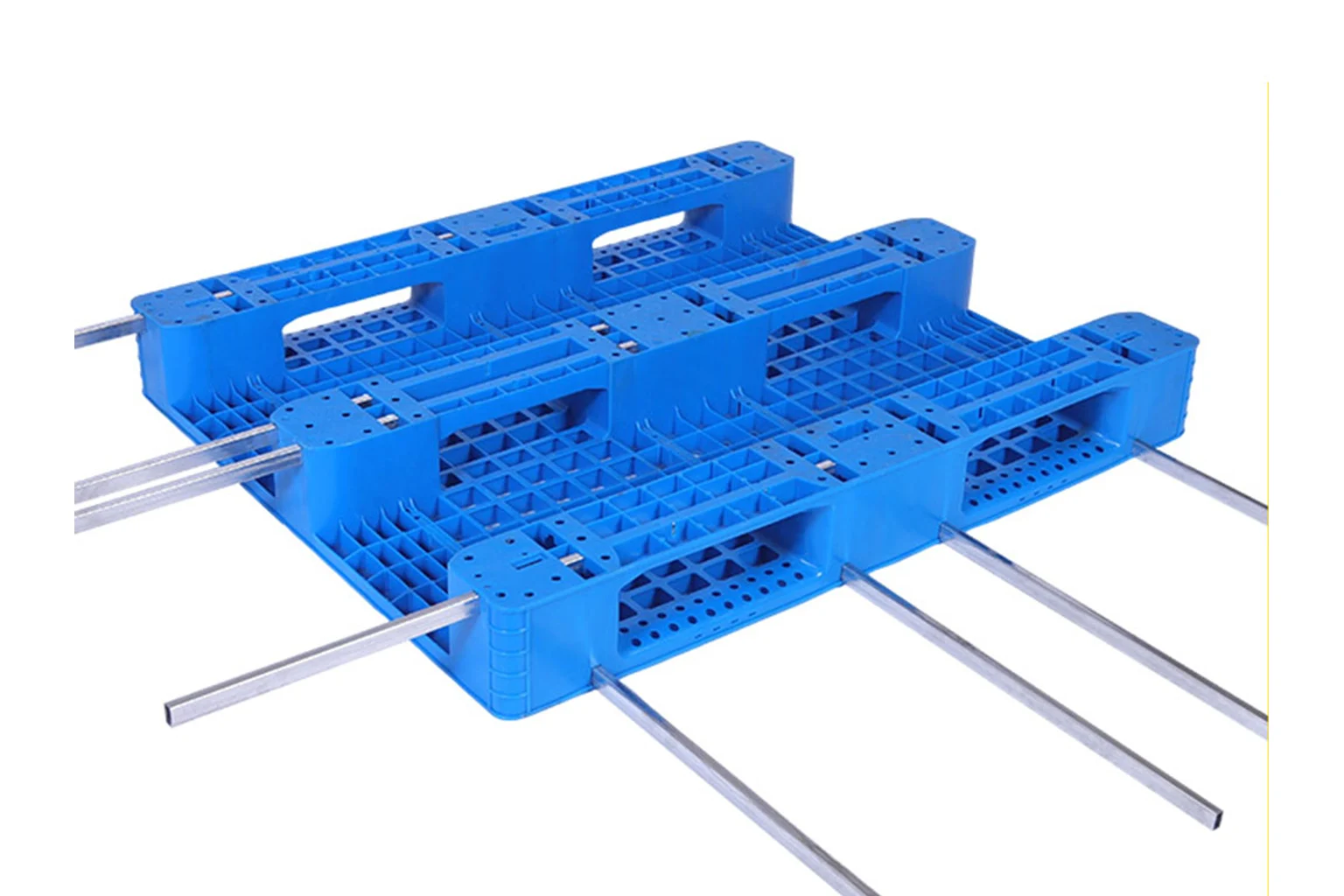
Do not insert, remove or alter reinforcement in an in-service pallet without a method and approval from the responsible supplier or pallet owner. The projecting tubes in the cover image only illustrate positions; they do not show a completed operating configuration or a procedure for modifying a pallet.
Put the decision in the enquiry
Send BAOHENG the intended load and support details, candidate family and model, relevant equipment drawings, temperature, storage time and required quantity. Ask which configurations and supporting documents are available. Once the project reviewers agree on a sample and specification, keep the drawing and reinforcement details with the purchase record and agree which changes require renewed review.
The rack-load evidence worksheet helps compare offers using the same conditions. It does not certify an individual pallet.
Source reviewed on 14 November 2026: ISO’s public abstract for ISO 8611-3:2011. This guide provides an enquiry and review method; it does not report a BAOHENG test, a certified capacity or a universal reinforcement design.
