Replacing Wood Pallets in an AS/RS: Why Matching the Footprint Is Not Enough
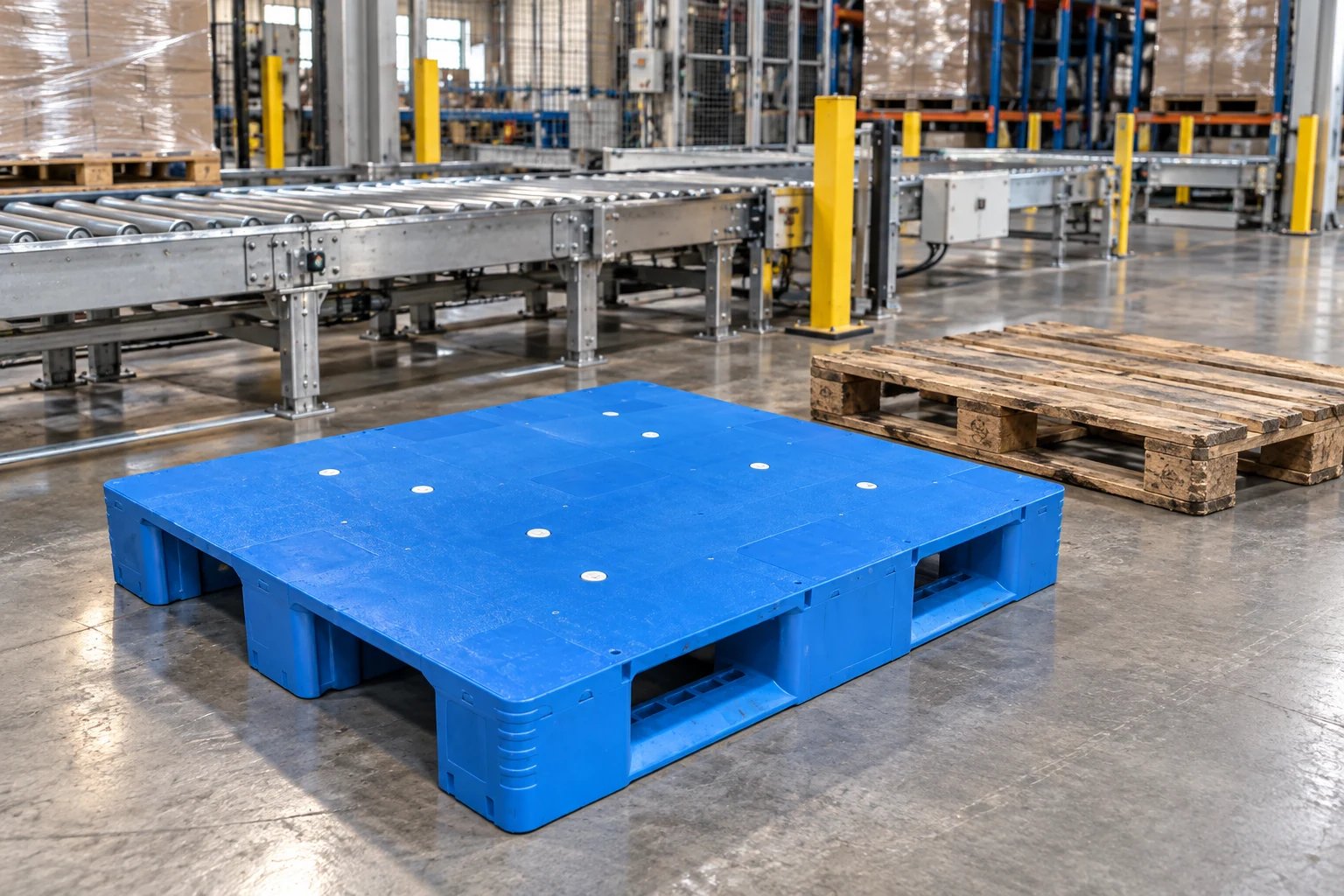
An established automated warehouse is preparing to phase out wooden pallets. The operating team wants to reduce splinters, moisture absorption, repairs and dimensional variation between replacement batches. Because the current pallet footprint is 1200 × 1000 mm, the first proposal is simple: purchase a plastic pallet with the same outside dimensions and leave the system unchanged.
This scenario combines conditions commonly found in retrofit projects. It does not describe a specific customer installation, and the dimensions and operating examples are not product-performance claims.
The equipment interface is what actually changes
Length and width describe the space a pallet occupies. They do not describe how it makes contact with the system. Deck-board gaps, stringer width, bottom-board position, chamfers and even exposed fasteners may already be part of the operating assumptions built into the existing conveyor and storage equipment.
A plastic pallet with the same footprint can present a very different underside. Runner spacing may shift away from the chain tracks. A stop may meet an opening instead of a solid face. A sensor that used to detect a wooden board may now see a recessed blue surface. These are interface changes, even when the purchasing specification lists the same nominal size.
The project should therefore begin by mapping the entire pallet journey:
- where rollers or chains support the pallet;
- where stops, pushers and centering devices make contact;
- which direction lift trucks and stacker-crane forks enter;
- which surface each sensor is expected to detect;
- whether storage support comes from beams, rails or a shuttle platform;
- where the pallet is temporarily unsupported during a transfer.
“Suitable for automated conveying” is not a sufficient requirement. Every critical transition needs a defined contact pattern and clearance.
Three-runner or full-perimeter base?
Where the route has one consistent travel axis, three continuous runners can create a clear support direction and make chain alignment easier to review. A solid three-runner pallet can also provide continuous deck support for cartons, small-footprint containers and flexible packages.
Where the pallet rotates, changes direction or needs stable perimeter contact during stacking, a grid full-perimeter pallet may offer a more adaptable contact pattern. It still needs to be checked against the center of the turntable, transfer gaps, lifting elements and rack supports. A full-perimeter base does not mean universal equipment compatibility.
The right question is not which base looks stronger. It is which base maintains predictable contact throughout the complete route.
Recheck long-term storage behavior
Wood and HDPE do not respond to sustained load, temperature and support span in the same way. Years of successful operation with a wooden pallet do not establish the performance of a plastic replacement across the same rack opening.
The review should include the total unit-load mass, actual contact area between the load and deck, center of gravity, maximum rack dwell time, temperature range and clear support span. A load concentrated near the center of the deck may require a different structure or steel-tube layout than an evenly distributed load of the same total mass.
Use a staged approval process
A controlled conversion normally progresses through four steps:
- Interface review: compare the existing pallet, equipment drawings and measured contact points.
- Empty-pallet trial: run a sample through every conveyor, lift, turn, stop and sensing position.
- Representative loaded trial: reproduce the real load footprint, center of gravity and wrapping method, then place the sample in the actual storage location.
- Limited operational release: operate a small batch under monitored conditions before expanding the conversion.
Acceptance criteria should be agreed in advance. They may cover positioning tolerance, transfer stability, allowable load overhang, test temperature and inspection intervals. This makes it easier to distinguish a pallet issue from a packaging or machine-setting issue.
Compare direct replacement with a carrier-pallet route
If inbound goods arrive on several pallet types, direct replacement is not the only route to investigate. A warehouse may instead place a loaded inbound pallet onto a separate, controlled carrier pallet—also called a slave pallet—for the part of the journey inside the automated system. In an Interlake Mecalux project, operators place incoming load pallets on such carriers before the system’s inspection checkpoint; the carriers are separated and returned for reuse at outbound. This is that integrator’s project, not a BAOHENG installation or evidence that a BAOHENG model is approved as a carrier.
Compare the two routes against the actual project:
- Contact and support: for direct replacement, check the replacement pallet’s deck, underside, rack support and pickup interfaces. For a carrier, check the inbound pallet’s contact with the carrier as well as the carrier’s equipment and rack interfaces.
- Complete unit: measure the finished load with the replacement pallet; for a carrier, include both pallets, goods and packaging in the combined dimensions and both pallet masses in the total.
- Operations: plan how goods or pallet supply will change over for a replacement. A carrier route also needs placement, separation, empty-carrier return, inspection and clear responsibility for both pallets.
- Evidence: assess the proposed replacement configuration and representative loaded route, or the identified inbound-pallet/carrier combination and its representative loaded route.
A carrier adds its own height and mass and may change the load’s centre of gravity, contact pattern and sensing surfaces. Its availability does not make every incoming pallet acceptable: the goods, incoming pallet and carrier still need to satisfy the agreed stability, support, profile and equipment criteria. A separate carrier also requires space, handling and a return loop; compare those requirements with the intended throughput and existing layout rather than assuming a cost saving.
Ask the equipment provider and pallet supplier whether the proposed arrangement can be reviewed for the specific incoming pallet types, load patterns and rack supports. Record the combined unit’s maximum dimensions, total mass, contact areas, movement and pickup sequence. If the system cannot accommodate the combination, keep it as an unresolved option and evaluate replacement or another approved workflow. Use the unit-load dimensions guide and the sample acceptance checklist to prepare the joint review.
Decision outcome
Converting an AS/RS from wood to plastic is a load-carrier interface project, not simply a material substitution. The best outcome may retain the original footprint while changing the base pattern, reinforcement or anti-slip configuration. In other cases, the equipment or unit load may need a limited adjustment.
For an initial review, provide the current pallet drawing, unit-load details, conveyor route, rack-support drawing, temperature range and planned conversion volume. BAOHENG can use this information to prepare a shortlist and sample-validation plan. Submit the project through Contact.
